9 apps you pay for every month, their open source alternatives, and the catch with each one
Open source alternatives on GitHub to Higgsfield, ElevenLabs, Semrush, Notion, Wispr Flow, Asana, Calendly, Intercom, and Loom, with the server, key, or license each one needs.
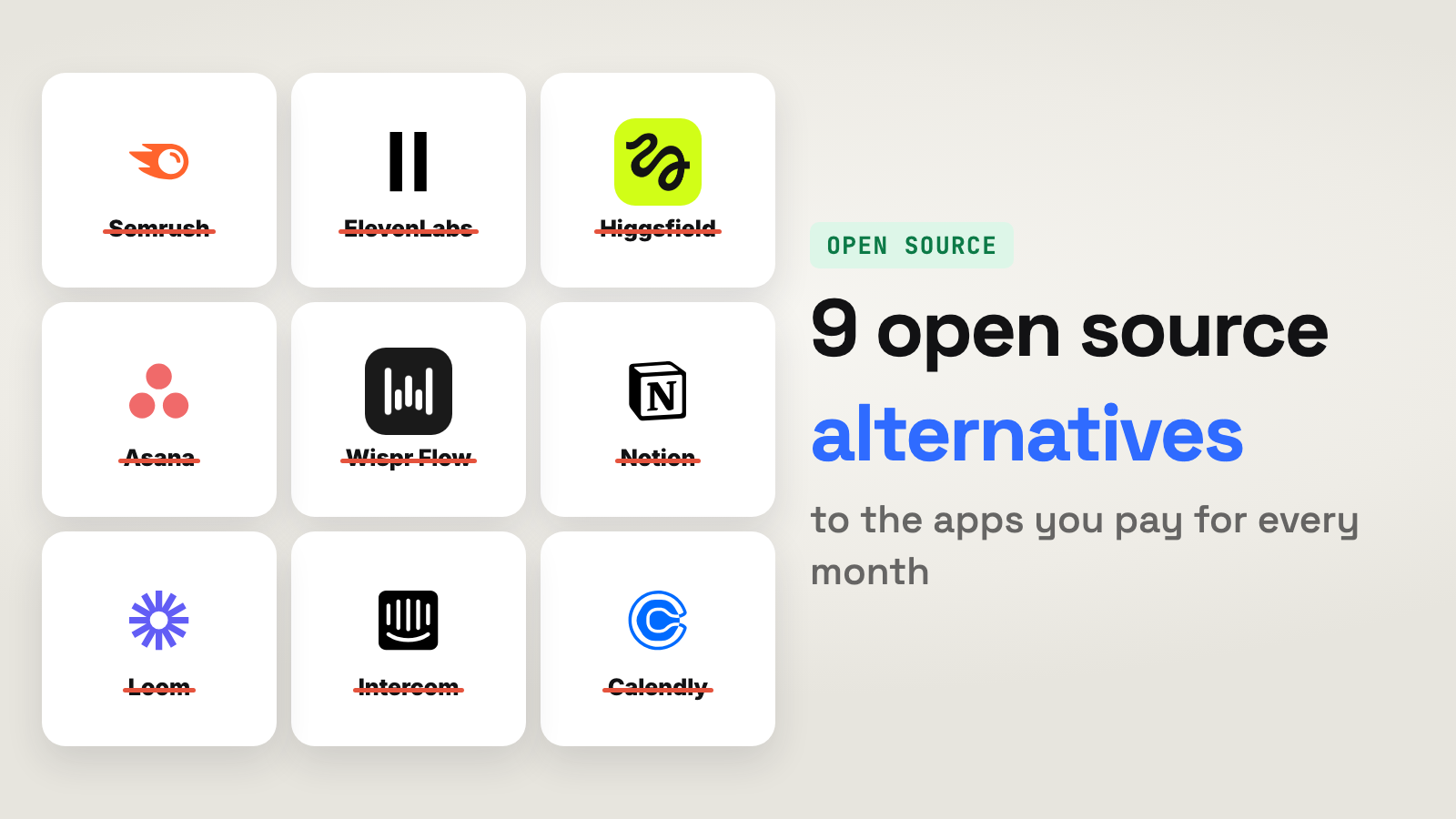
Many people pay for these nine apps every month, and each one has an open source alternative on GitHub. But "open source" doesn't always mean "completely free." Some of these alternatives need a server you run yourself, some need a key you pay for, and one asks for a license for commercial use.
The short version before the details:
- Open Generative AI instead of Higgsfield: the app is free, and the cloud models use a paid key.
- VoiceStudio instead of ElevenLabs: free, and it runs on your machine.
- OpenSEO instead of Semrush: no required subscription, and you pay for SEO data based on your usage.
- AppFlowy instead of Notion: an app for desktop and mobile, and its free cloud plan is limited.
- OpenWhispr instead of Wispr Flow: free, and it works offline with local models.
- OpenProject instead of Asana: a free community edition on your own server.
- Cal.diy instead of Calendly: free on your own server, and they recommend it for personal use only.
- Chatwoot instead of Intercom: open source on your own server.
- Cap instead of Loom: free for personal use, and commercial use needs a license.
We wrote this list from the projects' official pages on November 4, 2026, and we did not try the tools ourselves. Star counts are from GitHub on the same day. They show how widely a project has spread, and they say nothing about quality. Prices and terms change, so check the project's page before you rely on it.
1. Open Generative AI instead of Higgsfield
A studio for generating images and video and for lip sync. It's MIT licensed and has 32.2k stars. The project lists more than 600 models.
Watch out: these models are cloud-based and run on a key from Muapi, a service that charges you for each generation. You can skip the key if you stick to the local models in the desktop app, but those are far more limited. The built-in engine does images only, and generating video locally requires installing Wan2GP yourself on a machine with an NVIDIA or AMD graphics card.
The project promotes itself as having no content filters. That doesn't exempt you from the models' terms or from the law.
github.com/Anil-matcha/Open-Generative-AI
2. VoiceStudio instead of ElevenLabs
An app that runs on your machine: voice cloning, designing a voice from a description, video dubbing, dictation, and turning books into audio. It's licensed under AGPL-3.0 and has 100.8k stars. The project says it's free and that it runs without a graphics card, only slower.
Watch out: each model and voice has its own license, and the app shows it to you, so read it before you use the output in commercial work. Don't clone anyone's voice without their permission, which is also the project's own condition. The project is new. It started in April 2026.
github.com/debpalash/VoiceStudio
3. OpenSEO instead of Semrush
Keyword research, rank tracking, competitor analysis, backlinks, and site audits. It's MIT licensed, has 26.4k stars, and connects to agents like Claude Code over MCP.
Watch out: it needs a DataForSEO key, and you pay them directly based on your usage. So there's no subscription, but there is a cost. It also has a hosted version you can try for free. That subscription costs $10 a month, and they add 28% to each request to DataForSEO.
4. AppFlowy instead of Notion
Notes, documents, and projects. It's licensed under AGPL-3.0 and has 78.2k stars. It has apps for macOS, Windows, Linux, iPhone, and Android, you can host it on your own server, and it has a guide for running AI locally through Ollama.
Watch out: its free cloud plan is limited: 100 MB of storage, 7 MB per file, and only a limited trial of some AI features. The Pro plan starts at $12 per member per month, billed annually.
github.com/AppFlowy-IO/AppFlowy
appflowy.com/guide/appflowy-local-ai-ollama
5. OpenWhispr instead of Wispr Flow
You press a shortcut and talk, and your words appear at the cursor in any app. It's MIT licensed, has 10.7k stars, and runs on macOS, Windows, and Linux. The local models work offline, or you can use a cloud model with your own key.
Watch out: we did not test its accuracy in any language, including Arabic and its dialects, so try it with your own speech before you rely on it. On Intel Macs, speaker identification isn't available.
github.com/OpenWhispr/openwhispr
6. OpenProject instead of Asana
Tasks, Kanban boards, Gantt charts, time tracking, and portfolio management. It's licensed under GPL-3.0 and has 17k stars.
Watch out: the free option is the Community Edition you install on your own server, so hosting, updates, and backups are on you. There's also a 14-day cloud trial, and an Enterprise edition with add-ons and support.
7. Cal.diy instead of Calendly
A page for booking appointments. It syncs with Google Calendar and Outlook once you set up their keys yourself. It's the community edition of Cal.com, fully MIT licensed, with 49.7k stars.
Watch out: this is the biggest condition on the list. The project warns at the top of its page that you use it at your own risk, and it recommends it for personal use rather than production. Teams, organizations, workflows, and SSO have been removed from it, and there's no hosted version. For companies, they point you to Cal.com.
8. Chatwoot instead of Intercom
One inbox for messages from your website, email, WhatsApp, Instagram, Facebook, Telegram, SMS, and more. It has 38.9k stars and an AI assistant called Captain.
Watch out: the core code is MIT licensed, but the enterprise folder has a separate license, so make sure the feature you want is in the open version. Running it on your own server means maintenance and customer data are your responsibility.
9. Cap instead of Loom
Screen and camera recording with an editor and a share link, on macOS, Windows, and Linux. Most of its code is AGPL licensed, it has 24.4k stars, and you can host it entirely on your own server.
Watch out: the free tier is for personal use only, according to the pricing page, and it gives you 25 share links a month with a 5-minute limit per video. Commercial use needs a license at $29 a year or $58 one time, and Cap Pro is $12 per user per month.
Which one should you try first?
- You want something that runs on your machine today: VoiceStudio, OpenWhispr, and AppFlowy, plus Cap if your use is personal.
- You have a server or are ready to set one up: OpenProject and Chatwoot, plus Cal.diy for your personal appointments.
- You don't mind paying for what you use: OpenSEO and Open Generative AI.
If you want Claude Code to set one of them up, here's a request to start with. Swap the project name for the one you want:
I want to try AppFlowy on my machine. Read the README in its GitHub repository, then tell me the requirements, the cost, and what will be installed before you start. Don't open any port to the internet, and don't enter any key or password, until you have my approval.What to watch out for
Free moves the cost to your time. The server, updates, backups, and security become your job. Factor that in before you cancel a subscription your work depends on.
Customer data is your responsibility. If you run Chatwoot or OpenProject on your own server, protecting the data in it falls on you instead of a company.
The AGPL license has conditions. If you modify software under this license and offer it to people as a service over the internet, you must make the modified code available to them. If you're building a commercial product on top of it, ask a specialist.
Don't move everything at once. Try one tool on non-sensitive work, and keep your current subscription until you're sure the tool is enough for you.
Follow us at @nexcodekw.